
Living by the Word
A Selective Bible Study on Psalm 119
Why Psalm 119?
Backdrop
This Psalm is known as an acrostic poem. It is divided into 22 sections, or stanzas, with each one corresponding to a letter of the Hebrew alphabet, from aleph to tav. This structure helps readers recognize both completeness and order. Each stanza contains 8 verses, and all of them begin with the same Hebrew letter. For example, in the first stanza (verses 1–8), every verse starts with aleph. This acrostic form emphasizes the Psalm's theme: the completeness of God's Word, which encompasses all aspects of life from "A to Z" (or aleph to tav). Scholars suggest that it serves not only as a poem but also as a tool for teaching the Hebrew alphabet and the deeper meanings of life. This perspective is quite compelling. Some translations highlight the name of each alphabet letter before every stanza, starting with the first set of eight verses labeled with א (aleph), followed by ב (bet) for the second, and so on.
For this study, we focus exclusively on the author's admiration for God's word. Using the Amplified Bible, we selected all Psalms verses that reference it. To enhance our understanding, we utilized Strong’s references, which reveal that the term "word" has two different meanings in Hebrew: "dâbâr" (or “daw bawr”) and "'imrâh" (or "'emrâh"). We included the corresponding Strong’s definitions at the end of each verse. Although there does not appear to be a significant difference between these two definitions in English translations, a thorough understanding of Hebrew is needed to grasp the full distinction. For our purposes, we aim to establish that God's word is indeed His spoken word, as confirmed by Strong’s for each applicable verse.
The Hebrew word דָּבָר (“dâbâr,” Strong's H1697) is translated into English as "word," "promise," "command," or "law," depending on the context. The Hebrew term אִמְרָה (pronounced "imrah," Strong's H565) is most commonly translated as "word," "saying," "speech," or "promise." Its meaning is closely related to דָּבָר (“dâbâr,” H1697), but “imrah” often has a slightly more specific emphasis on spoken or promised words, particularly those of God or divine utterances.
It can be assumed that God’s word was available in both written and oral forms at the time the Psalm was composed, whether it was before or after the exile. While exploring the content of God’s word—both spoken and written—during that period would be fascinating, that is a separate study. For our purposes, in the context of the Psalm, “word” primarily refers to God’s written word as we find it in the Bible.
Question Format
Psalm 119 is a deeply meditative psalm that focuses on the beauty, power, and application of God's Word. It uses terms such as "law," "commandments," "statutes," "precepts," "word," and "promises." For this study, we will concentrate specifically on the term "word" and have narrowed down the theme to the verses that include it. There are only two verses in the Psalm that do not include any references to the word.
When conducting a Bible study on the entire Psalm, you may choose to journal your thoughts for each verse or for the Psalm as a whole. As you do this, pay attention to how the verses relate to the theme associated with the Hebrew letter of each stanza. This method will help you identify patterns, themes, and personal insights throughout the Psalm.
As previously mentioned, we will focus only on the verses that reference the "word" in one of its specified formats. Below are the questions for each selected verse in our study:
Psalm 119 - Verse Selection
Verse 9
Verse 9
"How can a young man keep his way pure? By keeping watch [on himself] according to Your word [conforming his life to Your precepts]". ("dâbâr”)
• What ways have you found to keep your life aligned with God's word?
• What role does God's word play in helping a person live a pure life, according to this verse?
• What method does Psalm 119:9 recommend for maintaining purity in one's life?
• What is the keyword in this verse?
• What ways have you found to keep your life aligned with God's word?
• What role does God's word play in helping a person live a pure life, according to this verse?
• What method does Psalm 119:9 recommend for maintaining purity in one's life?
• What is the keyword in this verse?
Verse 11
"Your word I have treasured and stored in my heart, That I may not sin against You." ("'imrâh")
• What practical steps can you take to start 'hiding' more of God's Word in your heart?
• What is your favorite method for memorizing or internalizing scripture?
• What practical steps can you take to start 'hiding' more of God's Word in your heart?
• What is your favorite method for memorizing or internalizing scripture?
Verse 16
"I will delight in Your statutes; I will not forget Your word." ("dâbâr”)• What does the psalmist's commitment to delighting in God's laws reveal about the nature of God's law?
• What steps can we take to engage with Scripture in a way that promotes both joy and obedience??
• How can we remind ourselves of God's word during challenging times when we might be tempted to forget it?
• What is your favorite verse or passage from the Bible, and why does it resonate with you?
• What is the keyword in this verse?
Verse 17
• What does the psalmist ask God to do to help him live?
• In what ways does recognizing God’s teaching in our lives help us in our spiritual growth?
• What are some practical steps you can take this week to prioritize learning and living out God’s teachings?
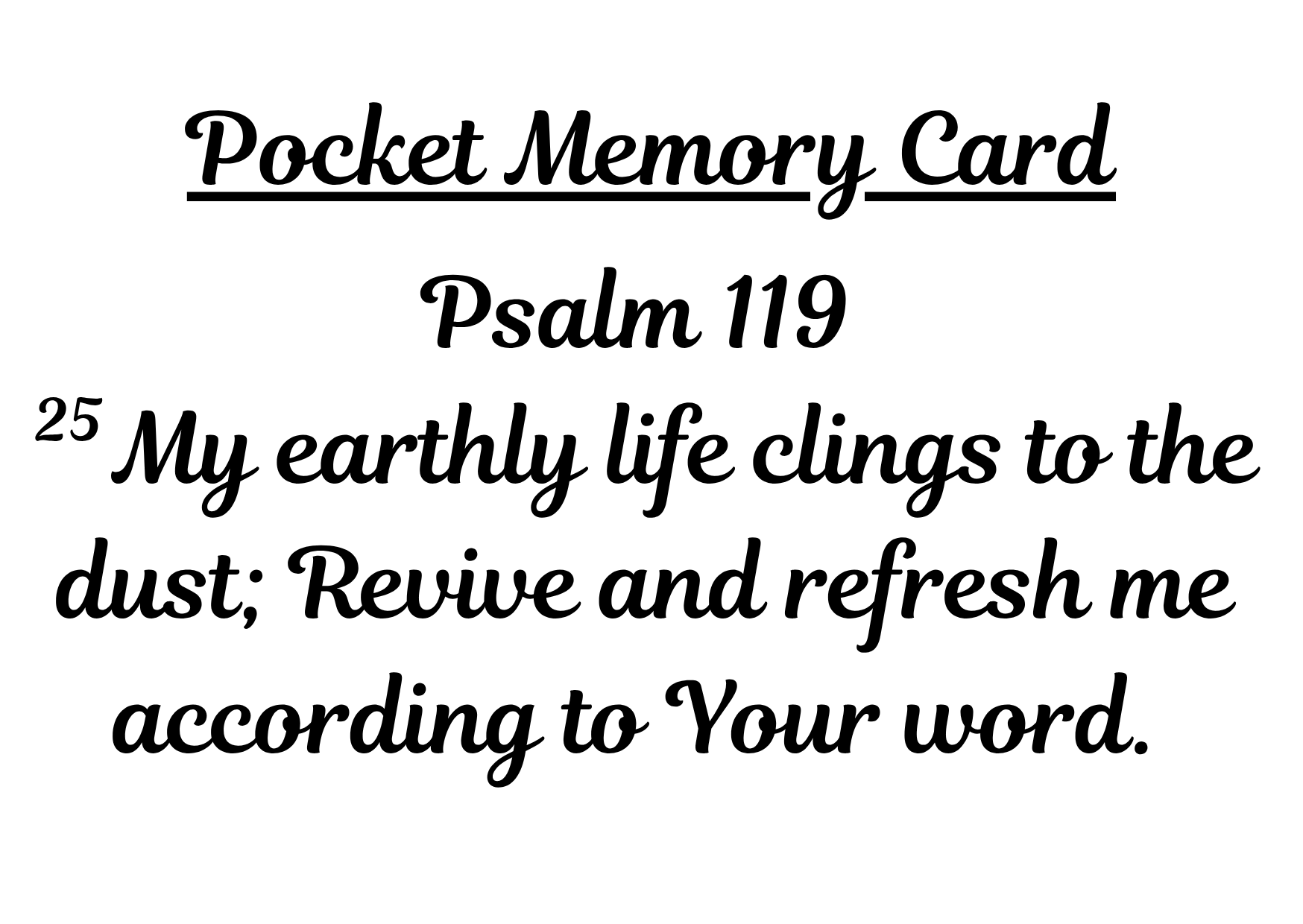
Verse 25
"My earthly life clings to the dust; Revive and refresh me according to Your word." ("dâbâr”)• What do you believe the psalmist is expressing about his state of mind in this verse?
• What practices or habits do you find most helpful in maintaining your hope and faith in challenging times?
• Are there any areas in your life where you feel 'down', and how can this specific verse shape your mindset as you navigate those feelings?
Verse 38
"Establish Your word and confirm Your promise to Your servant, As that which produces [awe-inspired] reverence for You." ("'imrâh")• What does the phrase 'establish your word to your servant' mean to you?
• What personal practices do you utilize to ensure that you are consistently aware of God's word in your daily life?
• In what ways do you see God's faithfulness reflected in your own life, and how does that influence your trust in Him?
Verse 42
"So I will have an answer for the one who taunts me, For I trust [completely] in Your word [and its reliability]." ("dâbâr”)• What does this passage reveal about the importance of scripture as a foundation for our responses to challenges in life?
• What actionable steps can you take this week to allow God’s word to shape your decisions and interactions with others?
• What specific actions can you take to engage with scripture more regularly?
Verse 49
"Remember [always] the word and promise to Your servant, In which You have made me hope." ("dâbâr”)• How does Psalm 119:49 challenge you to deepen your connection with God's Word in practical ways?
• In what ways do you see God's faithfulness demonstrated through His word in your own experiences?
Verse 50
"This is my comfort in my affliction, That Your word has revived me and given me life. And turned my feet to [follow and obey] Your testimonies." ("'imrâh")• What does the writer of Psalm 119:50 mean when they refer to God's promises as a source of comfort?
• What does this verse teach us about the nature of God's love and promises toward us?
How do you personally draw strength from God's Word during challenging moments in your life?
Vere 74
"May those who [reverently] fear You see me and be glad, Because I wait for Your word." ("dâbâr”)• What does the phrase 'those who fear you will see me and rejoice' mean in the context of Psalm 119:74?
• What emotions or thoughts does the psalmist experience when he speaks of hope in God's word?
• How does Psalm 119:74 reflect God's character as one who provides comfort and support to His people?
• In what areas of your life are you currently seeking encouragement from God's word, similar to the psalmist?
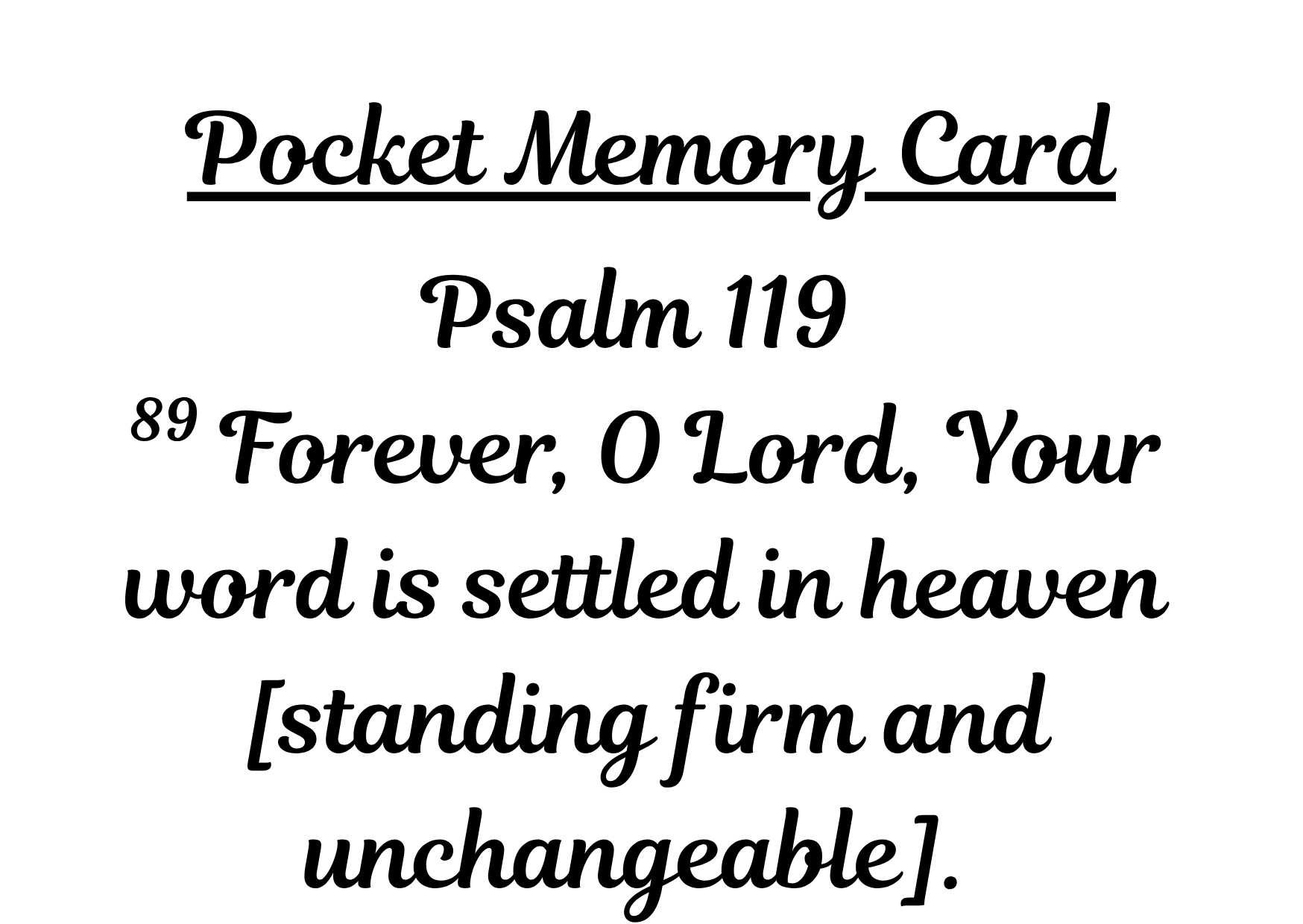
Verse 89
"Forever, O Lord, Your word is settled in heaven [standing firm and unchangeable]." ("dâbâr”)• What does Psalm 119:89 mean when it states that God's word is settled in heaven?
• In what ways does this verse reflect God's unchanging nature?
• What steps can you take to meditate on God's Word throughout the week intentionally?
Verse 98
"Your commandments make me wiser than my enemies, For Your words are always with me." ("dâbâr”)• What does this verse reveal about the relationship between God's commands and wisdom?
• How can we actively seek and apply the wisdom of the scriptures in our current life situations?
• In what ways can we see God's law as a source of insight in our daily lives?
Verse 101
"I have restrained my feet from every evil way, That I may keep Your word." ("dâbâr”)• How does the word help prevent us from doing evil?
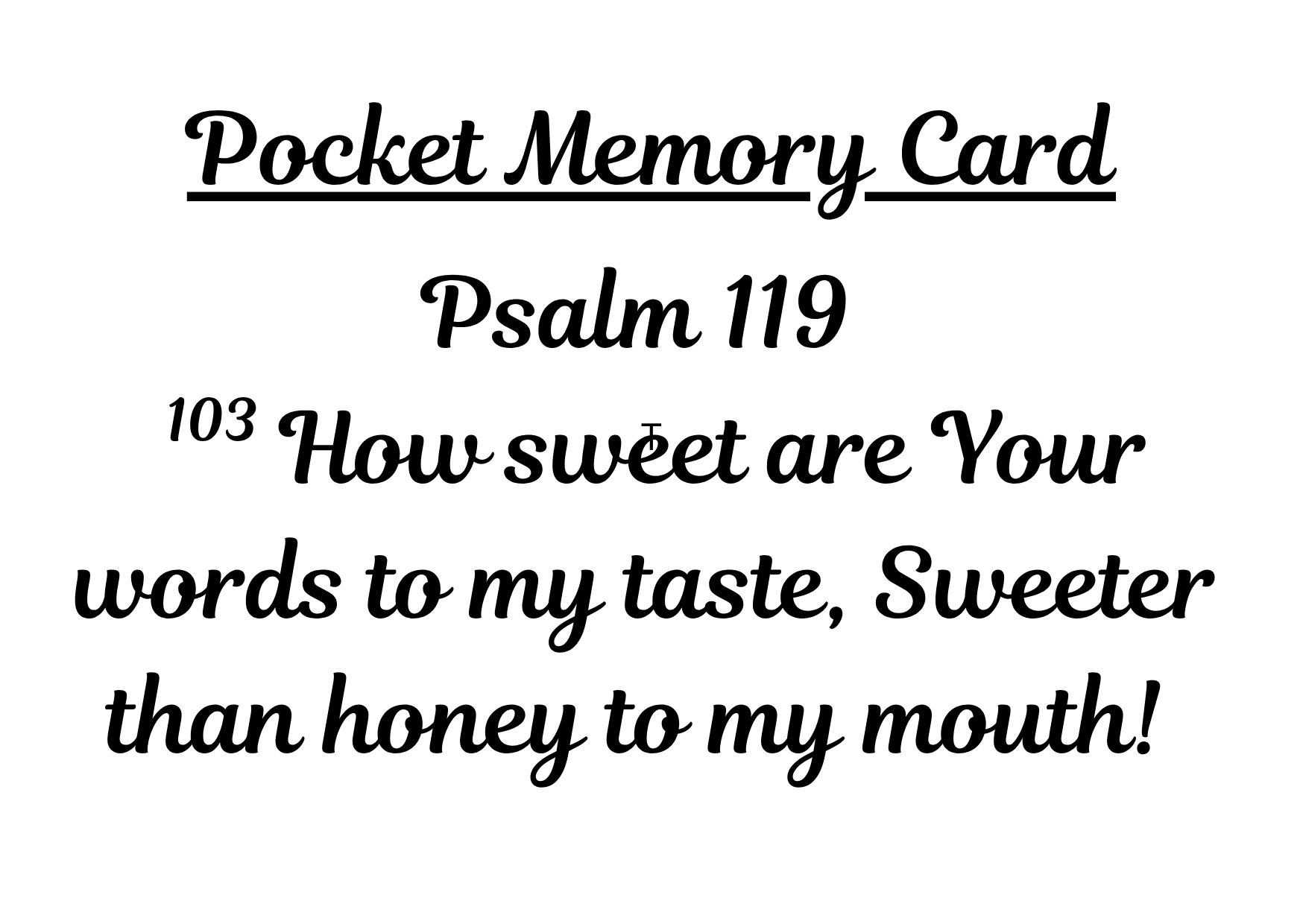
Verse 103
"How sweet are Your words to my taste, Sweeter than honey to my mouth!" ("'imrâh")• What does this verse teach us about the connection between God's word and our emotional or spiritual well-being?
• How can we practice scripture memorization to enhance our appreciation of its sweetness?
• What can we learn from this passage about the significance of meditating on God's word throughout our day?
• What are some practical ways to 'taste and see' the sweetness of God's Word in a busy life?
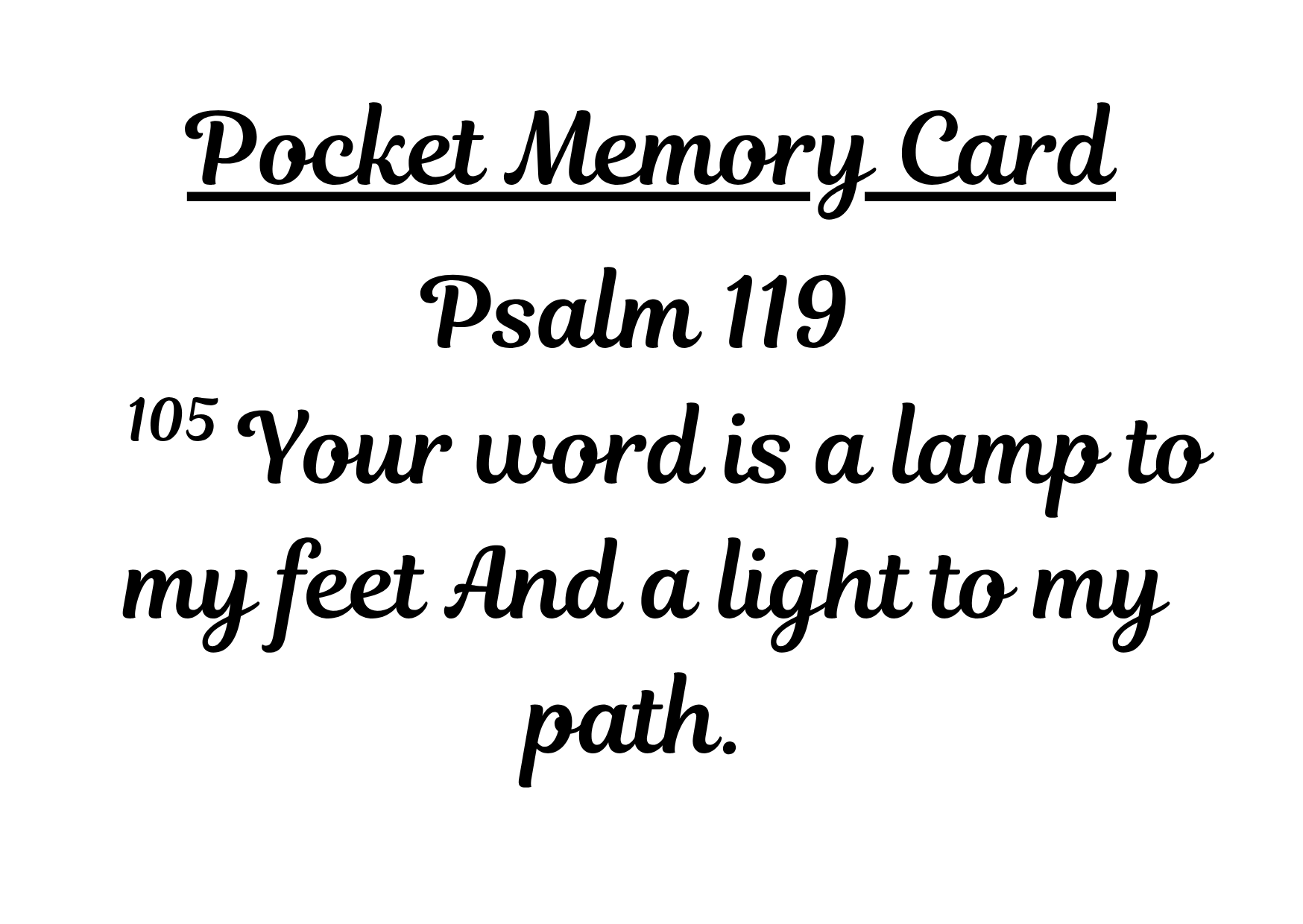
Verse 105
"Your word is a lamp to my feet And a light to my path." ("dâbâr”)• In what specific areas of your life do you find yourself seeking God's guidance the most?
• What does it mean to you that God’s word is described as a 'lamp' and a 'light'?
• What is one example of a time in your life when you felt directionless or lost? How did you find your way?
Verse 107
"I am greatly afflicted; Renew and revive me [giving me life], O Lord, according to Your word." ("dâbâr”)• What does this verse teach us about the relationship between God’s Word and managing adversity?
• How does the phrase 'I am severely afflicted' in Psalm 119:107 resonate with you personally or in your life experiences?
• What practical steps can you take to make scripture a more integral part of your response to hardship?
In what ways can we cultivate a habit of turning to God's Word when we face personal challenges?
Verse 114
"You are my hiding place and my shield; I wait for Your word." ("dâbâr”)What does it mean to you that God is described as your 'hiding place' as mentioned in this verse?
In what ways do you see God acting as a 'shelter' in your life during times of uncertainty?
How do you personally interpret what it means to 'hope in His word' as stated in this verse?
Verse 116
"Uphold me according to Your word [of promise], so that I may live; And do not let me be ashamed of my hope [in Your great goodness]." ("'imrâh")
• What does the psalmist mean when they ask God not to put them to shame, and how does this reflect their relationship with God?
• In what ways does Psalm 119:116 illustrate the significance of God's support in our lives according to scripture?
• What aspects of God's character are emphasized in this passage, and how do they provide comfort in your life?
• What does the psalmist mean when they ask God not to put them to shame, and how does this reflect their relationship with God?
• In what ways does Psalm 119:116 illustrate the significance of God's support in our lives according to scripture?
• What aspects of God's character are emphasized in this passage, and how do they provide comfort in your life?
Verse 123
"My eyes fail [with longing, watching] for [the fulfillment of] Your salvation, And for [the fulfillment of] Your righteous word." ("'imrâh")
• What does the phrase 'my eyes long for your salvation' convey about the author's feelings and emotions towards God in this passage?
• Can you share a personal experience in which you felt a deep longing for something significant in your life?
• What does this verse teach us about the significance of God's Word during times of waiting or struggle?
• What does the phrase 'my eyes long for your salvation' convey about the author's feelings and emotions towards God in this passage?
• Can you share a personal experience in which you felt a deep longing for something significant in your life?
• What does this verse teach us about the significance of God's Word during times of waiting or struggle?
Verse 130
"The unfolding of Your [glorious] words give light; Their unfolding gives understanding to the simple (childlike)." ("dâbâr”)
• What does the psalmist mean when they say, 'The unfolding of your words gives light'? How does this enhance our understanding of God's Word?
• In what ways does Psalm 119:130 reflect the importance of God's Word in revealing truth and guiding our lives?
• What practical steps can we take to allow God's Word to illuminate areas of confusion or darkness in our lives?
• What does the psalmist mean when they say, 'The unfolding of your words gives light'? How does this enhance our understanding of God's Word?
• In what ways does Psalm 119:130 reflect the importance of God's Word in revealing truth and guiding our lives?
• What practical steps can we take to allow God's Word to illuminate areas of confusion or darkness in our lives?
Verse 133
"Establish my footsteps in [the way of] Your word; Do not let any human weakness have power over me [causing me to be separated from You]." ("'imrâh")
• What does it mean for God to 'direct' your steps in this verse? Can you summarize the key idea?
• How can we understand the phrase 'let no iniquity have dominion over me' in light of God's sovereignty?
• How can you create a practical plan to ensure that you are seeking to follow God’s direction in your life this week?
• What does it mean for God to 'direct' your steps in this verse? Can you summarize the key idea?
• How can we understand the phrase 'let no iniquity have dominion over me' in light of God's sovereignty?
• How can you create a practical plan to ensure that you are seeking to follow God’s direction in your life this week?
Verse 140
"Your word is very pure (refined); Therefore Your servant loves it." ("'imrâh")
• How does Psalm 119:140 reveal truths about God’s character and His faithfulness in keeping His promises?
• How have you experienced God's word as a source of comfort and hope during difficult times?
• In what specific situations can you see yourself applying the teachings of this passage in your life this week?
• How does Psalm 119:140 reveal truths about God’s character and His faithfulness in keeping His promises?
• How have you experienced God's word as a source of comfort and hope during difficult times?
• In what specific situations can you see yourself applying the teachings of this passage in your life this week?
Verse 147
"I rise before dawn and cry [in prayer] for help; I wait for Your word." ("dâbâr”)
• How does waiting or longing for the Lord enhance our understanding of reliance on Him according to this passage?
• How does waiting or longing for the Lord enhance our understanding of reliance on Him according to this passage?
• In what ways does the concept of waiting for God differ from our culture's preference for instant gratification?
• When considering this verse, how can you redefine or adjust your understanding of waiting and hope in daily life?
Verse 160
"The sum of Your word is truth [the full meaning of all Your precepts], And every one of Your righteous ordinances endures forever." ("dâbâr”)
• How does our waiting or longing for the Lord deepen our understanding of reliance on Him according to this passage?
• How does our waiting or longing for the Lord deepen our understanding of reliance on Him according to this passage?
• How does the concept of waiting for God relate to our culture's desire for instant gratification?
• How can you redefine your understanding of waiting and hope in your daily life based on this verse?
Verse 161
"Princes persecute me without cause, But my heart stands in [reverent] awe of Your words [so I can expect You to help me]." ("dâbâr”)
• How can we find comfort in God's Word when we encounter challenges or opposition in our lives?
• How can we find comfort in God's Word when we encounter challenges or opposition in our lives?
• What does the verse mean when it refers to persecution, and how does this relate to the idea of righteousness?
• How does this passage demonstrate God's faithfulness to those who seek Him??
Verse 162
"I rejoice at Your word, As one who finds great treasure." ("imrâh")
• How does regularly praising God influence our relationship with Him?
• What are some practical steps we can take to incorporate more praise into our daily lives?
• What is your favorite way to praise or worship God this week?
• What are some practical steps we can take to incorporate more praise into our daily lives?
• What is your favorite way to praise or worship God this week?
Verse 170
"Let my supplication come before You; Deliver me according to Your word." ("imrâh")
• What does Psalm 119:170 teach us about God's nature and His relationship with us?
• How does this verse illustrate the significance of God's Word in our lives and its role in seeking help?
• How can we better understand the concept of salvation in this verse?
• How does this verse illustrate the significance of God's Word in our lives and its role in seeking help?
• How can we better understand the concept of salvation in this verse?
Verse 172
"Let my tongue sing [praise for the fulfillment] of Your word, For all Your commandments are righteous." ("imrâh")
• What does the phrase 'For all your commandments are righteous' mean in the context of Psalm 119:172?
• How do you perceive God's righteousness in your daily life experiences?
• What practical steps can you take to align your life with God's commandments more closely?
• How do you perceive God's righteousness in your daily life experiences?
• What practical steps can you take to align your life with God's commandments more closely?
Psalm 119 Bible Study Tools
Word Search Puzzle
This is a fun exercise. Word search puzzles provide entertaining relaxation, enhance learning by reinforcing vocabulary and spelling, and boost cognitive skills such as pattern recognition, focus, and memory. In this case, the theme is "Living by the Word". We selected keywords from the study's verses and included them in a word-search puzzle. The aim is to find the hidden words and to circle or highlight them. You can download and print both the puzzle and its answer. The word search puzzle is titled "Walking in the Word".
Living by the Word - Word Search Puzzle
Living by the Word - Puzzle Answer
Printable Verse List
We have made a printable word list of the verses in the study. Download it here
Memory Pocket Cards
We have created a selection of popular verses from the study in pocket card format. You can view or download them.
Verse 9
Verse 25
Verse 89
Verse 103
Verse 105
Visit our Bible Study Index page here for more Bible Studies by GAP Ministries.
Living by the Word - Word Search Puzzle
Living by the Word - Puzzle Answer
Printable Verse List
We have made a printable word list of the verses in the study. Download it here
Memory Pocket Cards
We have created a selection of popular verses from the study in pocket card format. You can view or download them.
Verse 9

Verse 25
Verse 89
Verse 103
Verse 105
Visit our Bible Study Index page here for more Bible Studies by GAP Ministries.